
My short term career goals are to get my bachelor's degree and begin teaching in a rural educational setting. I am especially interested in a rural setting because I grew up in that environment and I know about the sense of community that can be fostered and specific difficulties within a rural community. I would like to go back to the high school that I attended because I know the community well and the specific issue within the school. My long term goal is to get my Ph.D. in an educational specific program and teach at a university.
My Introductions
My name is Sidney Downham and I am studying to get my bachelor's degree in Secondary English Language Arts Education with a license addition in Reading and in the CEL program. The CEL program helps educators develop "high levels of technology skills and experience using new tools to help students learn." I have a strong passion and interest in reading, writing, and educational philosophy. I have worked in many different programs as a mentor and leader such as the INSPIRE LLC and the new School of Education Ambassadors program at Indiana University. In these programs, I have worked closely with preservice teachers to help them and myself develop educational skills and mentoring capabilities.
My interest in the CEL program stemmed from the original required course Computers in Education. I have never considered myself particularly tech-savvy, therefore, I knew it was a field that I had a lot to learn from. I also think it is important to recognize the growing importance of technology in the classroom. Therefore, the clear need for technology and my lack of knowledge is what originally interested me in the CEL program. The few CEL program courses that I have taken so far have been very informative about technology within education. I took a course on coding, which I am sure a lot of people would consider useless for a high school English teacher. However, this course taught me not only a basic understanding of coding, which is a very valuable skill in the 21st century, it also taught me how to integrate coding into my future English class. This course was also important to me because it taught me more about a skill that my future students may be interested in. Not every student loves reading and writing so if I can use my understanding of coding and programming to interest my students in their English class and to build a relationship with my students, I will consider it time very well spent.

The roles of an EdTech leader may be to encourage other educators to implement technology to either make their instruction more effective, more engaging, or more efficient. An EdTech leader may help other educators to see why technology is so vital within the classroom. The responsibilities of an EdTech leader may include showing educators how to use different tools in their classrooms. An EdTech leader may be responsible for writing grants so that their school or district can receive additional funding for technology for certain programs. The article The New Ed-Tech Leader Models by Digital Examples states that “It found that high-quality leadership was "essential" to better use of technology and that schools whose leaders had properly implemented 1-to-1 programs, for example, saw significant improvements in everything from test scores to dropout rates, over both schools without such programs and those without properly implemented programs.”
What is an Edtech Leader?
The meaning of the term EdTech leader is something that has been discussed and evaluated among may educators as technology integration changes in education. The article The New Ed-Tech Leader Models by Digital Examples states that the superintendent, “Larkin embodies the belief among a growing number of school administrators that getting educators to embrace digital teaching and learning, and to use technology more effectively, requires leading by example.” An EdTech leader is someone who takes the initiative to include, enhance, and educate others about ways that technology can be used in classroom instruction.
Characteristics that make up a good EdTech coach include someone who is passionate about technology integration into the classroom, someone who understands that technology may not be easy for others to work with, and someone who knows how to explain the importance of technology in the classroom. The article The New Ed-Tech Leader Models by Digital Examples states that “And there are characteristics and techniques that successful leaders in the ed-tech field share—everything from risk-taking to regularly using pilot projects to test initiatives before expanding them.” An EdTech coach needs to be patient because not everyone is always as interested in technology and they need to be resilient to show other teachers why technology is important. An EdTech coach should be a critical thinker so that they are always able to look at new tech and evaluate it effectively.
In my future, I can see myself as the lead EdTech coach in my department or perhaps even the “go-to” teacher for tech solutions. Ultimately, I see my future including a role that has me both advocating for technology in the classroom but also helping others realize technology goals within my school or possibly within my district. Above all else, I want to be someone who is able to help others understand the expansive ways in which technology can be used in the classroom and how it may help teachers connect more effectively with their students. Ultimately, Edtech leaders are an essential component of successful and ongoing tech integration within the 21st-century education system.

Learn Here
Evaluating Technology
Evaluating tools that you may use in the classroom is a crucial element for any sort of successful technology integration. Much like how English teachers evaluate books they may teach in the classroom, tech resources are equally as important to evaluate. It is important to note that even though a resource might work in a peer’s classroom, it may not have the same effect in your classroom because of the differences in tech integration, students, and overall lesson design
I recently evaluated Socrative, a tool that allows you to engage and assess your students as learning happens. Socrative is a tool for real-time quizzing, generating results, and visualizing progress. For me, the evaluation process always starts with me simply creating an account and spending some time playing with the new tool. It is crucial to understand the way the tool itself works before you are able to appropriately evaluate it. After becoming familiar with the resource, I evaluated Socrative based on a rubric in order to evaluate the tool effectively. As I evaluated the tool using the rubric, I considered where the tool fits in each element based on my own understanding of the tool. I also like to look online at how other educators have used and evaluated the tool on sites such as twitter.
The rubric I listed above is one of the best I have seen as far as evaluating tools go. I believe it covers important characteristics such as relevance, customization, feedback, thinking skills, usability, engagement, and sharing. I would expand on the rubric by adding a row about how accessible the tool itself is. Especially in online learning, not all students may have access to strong wifi. Or during traditional, in-person instructions, students do not always have access to resources at home. So can this tool be used at home without wifi? Can this tool be used offline? Especially in some rural areas where students cannot physically get wifi or cannot easily walk to places with wifi like a library, this is an important component to consider. Another important characteristic to consider about any tool is the price. Is the tool completely free, is it freemium (it has both free component and cost-based components), does it cost?
Technology for the reason of technology does not make sense and can often have a negative impact on student learning. It is important for educators to evaluate critically the tools they use in their classrooms and in their lesson plans because technology can have a large impact on the overall success of education as a whole. It is also important to teach students how to think critically about technology just as you may teach them to think critically about literary sources they use in a paper. As students continue to grow up in the 21st century and as technology becomes more of a critical component of everyday society, it is important to teach students how to think critically about technology and the tools they use in everyday life.
A Tutorial
The Monroe County Community School Corporation (MCCSC) stated that in their 2019-2020 School Improvement plan that “The Academy continues to be a member of the New Technology Network and focuses on a project-based, problem-based learning model with particular emphasis on developing 21st-century skills as well as mastering common core and state standards”. MCCSC has a 1:1 technology status, where "devices issued to students in grades K-5 remain at school each day while students in grades 7-12 take their devices home for use off-campus. In the event of a school designated contingency learning plan that includes eLearning days, students in grades 3-12 will take devices home." The school also utilizes a Student Digital Resources Page on its website where many different tools can be found such as ABCYa.com. Canvas, Discovery Education, Hour of code, and khan academy. MCCSC also has a bus service system that provides internet for online learning.
Pre-Field Experience: MCCSC District
One teacher states on twitter that “even though students aren’t in the building, you can hear so much learning going on with the live remote sessions!”. This semester I will be working with a Tech Coach at the district level for MCCSC for field experience. My expectations are rather high in that due to Covid-19 and the extreme need for e-learning that Tech Coaches are more vital than they ever have been before. Because MCCSC is a 1:1 district, I expect that it is one of the perfect systems to work with because I will have experience dealing with a full-scale tech integration at all levels of education. I am mostly looking forward to what types of challenges a school district deals with technology in a district like this one and in what ways ed tech coaches are helping teachers in their classrooms.
Future Questions:
-
In what ways or what resources are being offered to educators for technology-related professional development?
-
How is the district working with students who do not have access to or means of obtaining internet access and wifi connection? Is the current system successful?
-
What was it like developing a plan for the 2020-2021 school year due to Covid-19? In what ways were you, as an ed-tech coach consulted?
-
What are the daily tasks and expectations of you as an ed-tech coach in a district that utilizes 1:1 devices?
When exploring a school district’s technology setup and resources, it is important to always remember that a district wants to seem the best that it can. When exploring district tech integration, it is somewhat difficult to get a feel for the on-the-ground teacher experience. Because of this, it is important to always take time to look at actual teachers’ perspectives rather than only an administrative perspective. Exploring a district will always be a time lengthy process, especially if you are interested in a single aspect such as tech.
PLN stands for personal learning network and some key examples are twitter chats or Facebook groups. Finding a perfect PLN might be as easy as googling different teaching facebook groups or popular educational twitter chats. PLN’s are beneficial in education because they allow teachers from all over the world to work as a community to solve problems and to explore new resources. PLN’s can be about a specific topic like Canvas for educators or as broad as teachers asking teachers. The grade and topic variety allow teachers to integrate different resources and tools from all levels of education.
PLN- A Reflection

I participated in the Facebook group: Teachers asking teachers PLN. I choose this specific PLN because I wanted to experience something that covered many different topics in one group. Teachers asking teachers has a large variety of topics, members, grade levels, resources, and information. Some of the benefits of this PLN were the variety of topics, realistically you could get on the group discussion board and learning something new every day or be able to help someone with a new problem. Because this PLN included teachers from different subjects and grades, they were able to discuss the way in which different issues, like Covid-19, affected them. Overall, the group is a place that teachers from every level can come to ask for advice or to even just ask for emotional and mental support. The group has a fun meme discussion topic that is solely focused on making members laugh. One of the challenges was filtering through all the posts and comments. Because the group and the topics in the group are so vast, it can be somewhat overwhelming at first. The group also had a question approval system that took a long time to process questions. This is definitely a significant downside because sometimes issues that teachers are facing need to be answered ASAP.
If I were to participate in another PLN, I would like to work in one with a focused topic so that I could compare my experiences with broadly based and specific Facebook groups. PLN’s like teacher ask teacher can be beneficial because it creates a community that teachers can use to find new resources, answer questions, and share ideas. Broad topic PLN’s are great because it allows you to dip your toe into the world of PLN and because it caters to many different needs. I will continue to participate in this PLN even though I do not have a classroom yet because there is a lot of information for pre-service teachers as well. I am excited to use this support system in the future, especially for student teaching.


Differentiation is critical within any classroom or educational environment because no student is the same. Every student has different needs, challenges, and skills. Differentiation in education is when the teacher uses different tools, teaching techniques, and adaptations to the classroom or lesson because of the diversity and individualism in each student. Differentiation is often discussed around special needs students or English language learners, however, differentiation is not only important for these two specific groups of students. Differentiation is important for all students because of the way that student learns best, their interest, and their lives outside of the classroom. Differentiation speaks to the difficulty of teaching because educators must work to know their students exceptionally well and then make adjustments to a lesson to accommodate all those students. One of the key strategies in differentiating is using technology to your advantage rather than seeing it as a disadvantage. At times tech for the classroom can seem endless, this is sometimes both a positive and negative aspect of integrating technology because it can be both beneficial and overwhelming. However, because there are so many different tools available to educators, there are many great ways to differentiate using technology in the classroom and in lesson design.
Technology-Supported Differentiation
As a future English Language Arts teacher, differentiated instruction is crucial because it may be one of the most challenging and crucial classes for English Language learner (ELL) students and because it is required for every student’s graduation. Some great tools for ELL students include but are not limited to newsela, Duolingo, and Breaking News English. Differentiation for ELL students may look like allowing students to do a screencast of a presentation rather than doing it in class or including subtitles in videos. The resources and ideas are limitless. At the secondary level, many students struggle with English due to ability levels and interest in reading or writing itself. Therefore, differentiation in lesson design is critical so that lessons are engaging, enjoyable, and challenging for each student. Differentiated instruction should include authentic activities and assessments. For example, rather than assigning a paper at the end of every unit or lesson, you could have students create a video or presentation that shows their mastery of the subject matter. As a technology leader, it is crucial to use technology-related differentiation in your classroom so that you are able to guide and offer ideas or advice to struggling teachers about how to use technology in their classroom for differentiation. Differentiated instruction can be a challenging obstacle to overcome and to do successfully so always reach out to other teachers for ideas, consult tech leaders in your school or district, and don’t be afraid to use the internet to inspire new ideas and tech!
Makerspaces can come in many different shapes and sizes. Sometimes schools have an entire room dedicated to a makerspace or sometimes they can be a part of the school’s library. Makerspaces are collaborative work areas that students and teachers can use to explore new technology, learn about different computer science principles, or make resources. Makerspaces can have a variety of resources in them like laser cutters, 3D printers, circuit materials, or even sewing machines, the ideas are limitless! Makerspaces can also have more simple materials like paper, scissors, beads, or glue. The idea is that the space is somewhere students can collaborate with each other or a place for teachers to create something for the classroom. Makerspaces are important because they give students a space to use their creativity in a new and exciting way. Makerspaces also go hand in hand with problem-based learning and often computer science principles like computational thinking. Makerspaces are important because they allow educators to use tools and resources that would not normally be accessible in their own classroom to teach computer science principles along with content related ideas.
Makerspaces


I would pair the lesson from code.org, Digital Information Dilemmas, with the idea of media literacy in a social justice unit. Along with the standards addressed in the code.org lesson, I would also address the Indiana state standards: 9-10.ML.2.1 Analyze bias in media through the inclusion or exclusion of information and reliability of the source from visual and verbal messages to achieve a desired result and 9-10.ML.2.2 Analyze and interpret the changing role of the media in focusing the public's attention on events and informing their opinions on issues. At the end of the unit and lesson, I would have students create some production tools or resources that express the importance of social justice or media-related issue that they are interested in. As a current example for 2020, I would show students a t-shirt that was customized with a Cricut to stress the importance of wearing a mask during the epidemic. I would have students use the information that they learned in the code.org lesson plan, to search for facts, resources, and materials related to their chosen social justice topic. Students would then make a resource or tool in a makerspace related to that social justice issue. Therefore, not only will students learn the importance of social justice and the impact of their voice, but they will also learn about digital information literacy.

Working with a Cricut can be a really great way to teach students how to make something new or how to repurpose something they already own. Working with the Cricut, I learned the importance of step by step instruction. The Cricut could also be a great way to teach students how coding works as far as describing exactly what to do in each step. In my classroom, I want students to be able to make resources related to their passions and interests as much as possible, and makerspace is an excellent resource to do so. The possibilities of a makerspace are endless along with the possibilities of your students’ creativity.
Human Resource Management
Daughterty also gives the reader additional information to successfully and professionally hire new members of the IT team. When looking at resumes he suggests focusing on spelling and grammatical errors, incorrect software names, and previous experience in a service profession. Daughterty also lists the importance of showing up in an appropriate outfit and bringing some way to record information at an interview. In this book, Daughterty stresses the importance of being honest about your capabilities and your expectations when applying for jobs and the importance of askings interviewees the right
"Your team, regardless of size, will most likely follow a bell curve."
questions. Daughterty also points out that most of the time, technicians do not get to pick their team but rather make the most out of the team that they are given. Your team, regardless of size, will most likely follow a bell curve. Daughterty states that “the most effective way to handle a lazy employee is to have an open, direct conversation with that individual”. Daugherty also goes on to state that in order to motivate each individual on your team you must first individually meet “with each person on your team to better understand their goals and what motivated them to reach these goals”.
This blog post is based on the ISTE-A standard 4.3 - Human Resource Management.
The book Modern Edtech Leadership: A Practical Guide to Design Your Team, Serving Your Teachers, And Adjusting Your Strategy for the 21st Century, by Mike Daughterty is centered around supporting the transformation of school technology leaders and the teams that they work in. Daughterty provides many detailed explanations on how to improve team functioning, how to successfully conduct interviews, how to motive your team, and how to work with many different personalities within a single group. Daughterty points out that he was “once told that in a tech support role, you should never tell someone ‘I don’t know the answer,’” however, he has clear issues with this philosophy. First of all, it is unrealistic to expect every member of your team to always be able to fix every problem that anyone in the school runs into. Daughterty also points out that “as a technician, this puts you in a very awkward spot” because if do not know how to fix the problem, you are forced to lie to the person you are trying to assist. He suggests instead of answering with “‘Honestly, I’ve never dealt with this particular issue, but I am confident I can get this resolved for you.”
Overall, Daughterty’s Modern Edtech Leadership: A Practical Guide to Design Your Team, Serving Your Teachers, And Adjusting Your Strategy for the 21st Century stresses the importance of truly understanding who the individuals on your team are and how to most effectively and efficiently work with them within a team. It seems rather clear after reading Dauterty’s work that showing respect and creating time to get to know your team, is one of the best things you can do as a team leader.
"The best technicians have an outgoing personality coupled with strong technical knowledge."

Interview Questions
-
Tell me a little about yourself and why you feel you would be a good fit for the position.
-
What would you consider is one of your strengths?
-
What do you feel is your biggest weakness?
-
Where do you see yourself in 5 years?
-
What do you like to do in your spare time?
-
How comfortable are you with xx (Windows, servers, switches, imaging, etc)?
-
Tell me about a technical issue that was a major problem for your organization and how you solved it.
-
What do you do when you don't know the answer to a problem?
Field Experience Reflection
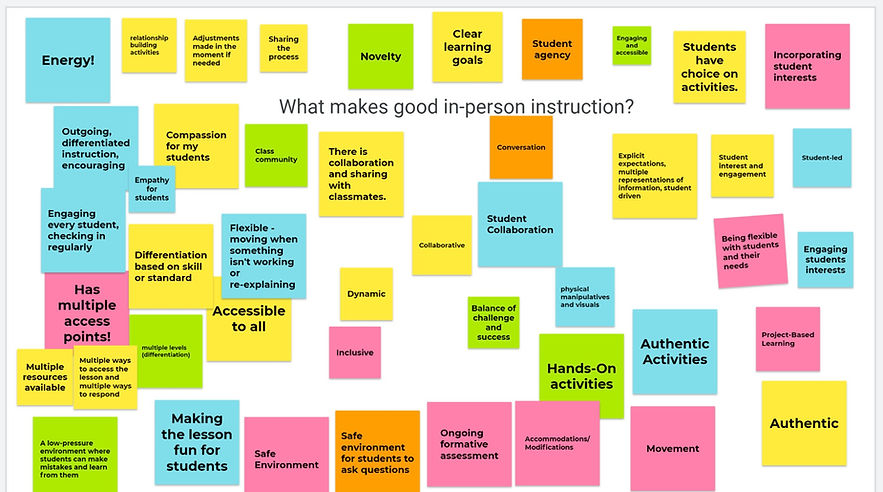
The program is still ongoing by my experience so far has been extremely valuable in understanding what elements create great online design versus in-person lesson design. Working with a team of highly experienced in-service teachers has given me insight into the different struggles of moving in person curriculum to a completely online setting. So far I have learned a lot about what makes great online instruction, along with how to work collaboratively with a team in order to produce a product that can be shared with other educators. One thing that I learned when working with the team to figure out what exactly makes great online lesson design and what makes great in-person lesson design is that often they have very similar elements including collaboration, authentic activities, engaging students, and clear learning goals. However, teachers who have excellent in-person curriculum design that includes problem-based learning, collaboration, or student choice have sometimes lost those design elements when moving to online instruction.
My field experience this semester was centered around working with Jacob’s Educators to develop different examples of successful, exemplary online elementary lessons and resources. The Jacob educator award is given to outstanding teachers from across the U.S. who are at the forefront of integrating technology to support problem-based learning. In addition to the seven in-service teachers from across Indiana who have been given the Jacob’s award, for the first time, seven IU school of education students have also been named as Jacob’s interns. You can learn more about the Jacob educators program, goals, teacher bios, and intern bios here.
.png)
One of the key insights that I gained from working with the team so far is how difficult it is to maintain equitable resources for students when they all do not have the exact same resources at home. Even when a school may have 1:1 devices, often students do not have the additional resources to use the devices such as a stable internet connection. While there are many different attempts to deal with this issue like providing buses with wifi, some students are still left at a major disadvantage.
lIt is clear that in online instruction technology is especially important and vital. Without technology, an online curriculum would be impossible. However, I have learned that technology can also make a lesson less effective or efficient if technology is not chosen or used correctly. Therefore, it is even more important for technology coaches and technology leaders to be aware that there will always be limitations to technology and that at times it can be more detrimental than beneficial. It is crucial for technology leaders to have a diverse set of technology tools that they know how to use and to recognize that not all tools are ideal for each individual educator, their lesson, or their students. While one teacher may love a tech resource, another teacher may not have the same results because everyone has different needs, strengths, and weaknesses.
_edited.jpg)
Along with inequitable resources, teachers, especially at the younger level, must also design lessons that are aware that not all students have additional help at home. Therefore, teachers must design lessons that are solely based on the age-groups capabilities. While in-person and online curriculum design goals may be similar, there are additional challenges that come with teaching online that not all teachers are prepared for.
_edited.jpg)
_edited.jpg)
Redefining EdTech Leadership
Wilhelmus's point is not only important for ed-tech leaders or coaches, it also increasingly important for anyone in the educational field whether that be the teachers or administrators. Teachers must not only understand the why for the information that they are teaching but also the why for their lesson design. If teachers are using technology for the sake of technology use simply because an Edtech coach said it was a great resource then they might be hindering their teaching rather than improving it. It is crucial for all teachers to even think about the why they are teaching, both the emotional and logical side, a key point of Wilhelmus's point. For example, I want to prepare students for real-world experiences and because of that, I am especially interested in authentic activities and problem-based learning. That why then informs what technology I use in the classroom and why, because for one teacher or coach a tech resource might be great for their why. However, it might not have the same impact on my why. Overall, Wilhelmus's point about the importance of the why is something that any individual within the educational system should think deeply about and continuously reflect on.
I recently watched an excellent webinar for veteran tech coaches in Indiana. Tim Wilhelmus points out that building your why to increase your relevance and reach. Much like Wilhelmus points out that often tech leaders become wrapped up in the tech rather than the why. I think this is an excellent point because sometimes tech is not always the answer to every fix in an educational setting or in the classroom. More importantly, as an ed-tech coach or leader, we must keep in mind the why. Why are we using technology, why is it beneficial, why it is relevant? These are key questions to ask yourself when thinking about integrating a piece of technology because it is not solely about the tech but far more importantly it is about the why.
In my second blog post that you can see above, I defined an ed-tech leader as someone who takes the initiative to include, enhance, and educate others about ways that technology can be used in classroom instruction. However, after working closely with Jacob’s educators to build an online lesson, I realized that my definition is not quite complete. While an ed-tech leader should be someone who has the initiative to include, enhance, and educate others about tech, an ed-tech leader is also someone who should
know the limitations of technology. For example, not only do ed-tech leaders need to be innovative to educate others about technology, but they should also be someone who shares the fact that technology has its limitations and that sometimes they can hinder your lesson rather than improve it.
Edtech leaders must be individuals who recognize that a tech tool is not a one size fits all resource and that individual teachers have their own whys that then inform how tech should be used in their classroom. Therefore, an ed-tech leader is someone who should be able to communicate and understand other individuals' whys so that they can work with teachers and administrators to improve class design and instruction. While ed-tech leaders may be responsible for writing grants and integrating technology into a school, even more importantly, their job is to connect with educators and administrators to combined the why’s in the educational community to ensure a successful learning environment, not only for students but for teachers and administration as well.